
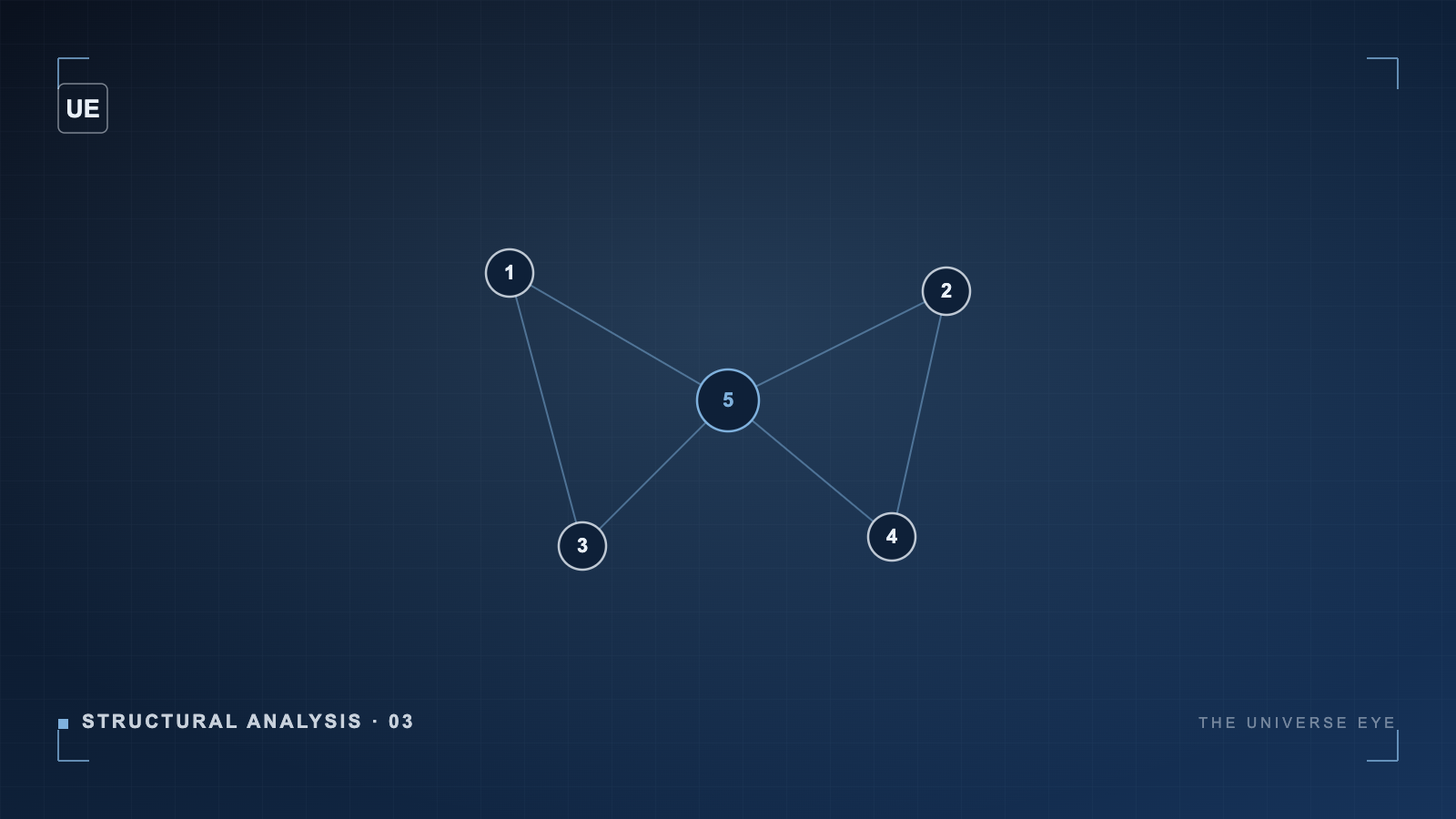
Reading an Institutional Structure: A Five-Step Entity Mapping Method
Analysis & Commentary
|
June 29, 2026
Reading an Institutional Structure: A Five-Step Entity Mapping Method
Entity Mapping Method
A five-step reference method for reading any institutional structure, from listing entities and mandates to tracing money, information, and control flows.
The Universe Eye
Structural Analysis · No. 03
Five-step method for mapping entities, mandates, and control flows in any structure.
Structural Analysis · No. 03
Any institutional structure (a group, a fund platform, a public authority) can be read with the same five-step method: inventory the entities, attach the mandates, then trace three flows: money, information, and control. The method turns an organogram into an analysable system and exposes the gaps organograms hide.
This document is reference material for institutional and analytical understanding. It is not legal, financial, tax, or regulatory advice.
Scope and method
This analysis presents a jurisdiction-neutral reading method. It assumes only that documents exist (founding instruments, charters, delegation schedules) and that observed behaviour can be compared against them.
Step 1: Inventory the entities
List every legal person and every internal organ that holds decision rights: parent, subsidiaries, vehicles, boards, committees, executive posts. The unit of analysis is the mandate-holder, not the box on the chart.
Step 2: Attach the mandates
For each entity and organ, identify the documented authority: source, scope, boundary. Unattached entities, active bodies with no traceable mandate, are the first finding, not a nuisance.
Step 3: Trace the money
Follow capital in and value out: contributions, loans, fees, distributions. Money flows reveal the structure's real geometry, which often differs from the chart's.
Step 4: Trace the information
Map what is reported, by whom, to whom, at what cadence. Oversight can only act on what reaches it; an information map is therefore a map of what governance can actually see.
Step 5: Trace the control
Identify who appoints, who approves, who can veto, and who can dismiss, across entity boundaries. Control flows that cross ring-fences or bypass documented mandates are the structural findings that matter most.
How this connects to the wider framework
Steps 2 and 5 apply mandate analysis directly; step 4 is the input side of the oversight stack; boundary-crossing findings are tested against ring-fencing logic.
Frequently Asked Questions
What is entity mapping?
A structured reading of an institution that inventories its entities and mandate-holders, then traces money, information, and control flows between them.
Why trace three separate flows?
Because they diverge: money may follow one path, reporting another, and control a third. Structural risk concentrates where the three maps disagree.
What counts as a finding?
Any active body without a documented mandate, any flow that crosses a compartment boundary without authority, and any control right invisible in the formal chart.
.avif)