
The Oversight Stack: Board, Committee, and Assurance Layers Explained
Analysis & Commentary
|
June 15, 2026
The Oversight Stack: Board, Committee, and Assurance Layers Explained
The Oversight Stack
A structural explanation of how boards, committees, and assurance functions stack into a single oversight system, and what each layer can and cannot see.
The Universe Eye
Structural Analysis · No. 02
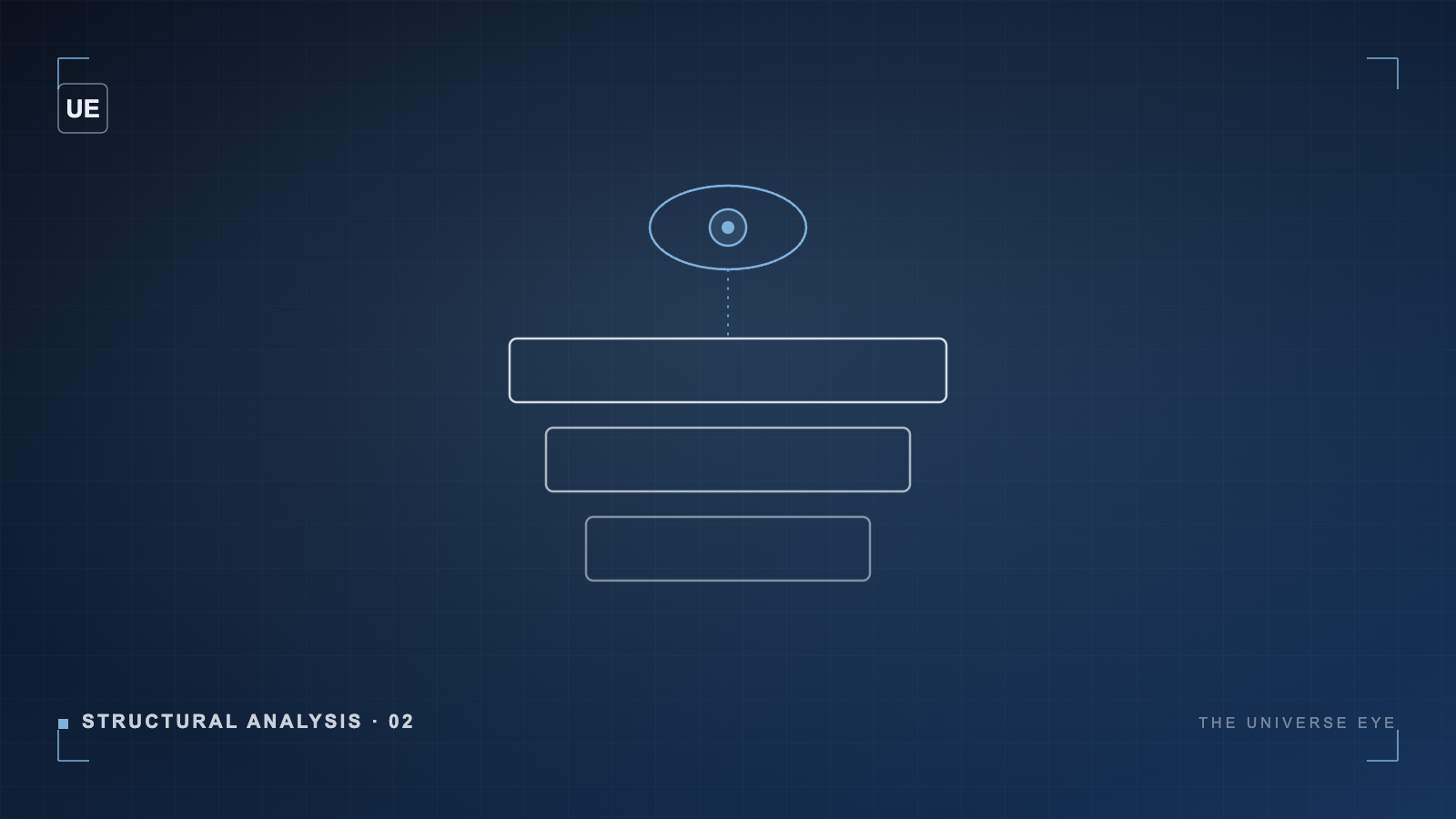
Structural view of board, committee, and assurance layers as one oversight system.
Structural Analysis · No. 02
Oversight in an institution is not a single body but a stack: a governing board at the top, specialised committees beneath it, and assurance functions that test what both are told. Each layer sees a different slice of reality at a different frequency. Understanding the stack as one system, rather than as separate bodies, is what makes oversight analysable.
This document is reference material for institutional and analytical understanding. It is not legal, financial, tax, or regulatory advice.
Scope and method
This analysis describes oversight layers at a framework level, without reference to any specific entity or jurisdiction. Layers are compared on three dimensions: visibility (what information reaches the layer), cadence (how often it convenes), and instrument (what the layer can actually do: approve, direct, recommend, or report).
Layer 1: The governing board
The board holds the widest formal authority and the narrowest bandwidth. It sees synthesised information on a quarterly or monthly cadence, and its instruments are approval, appointment, and direction. A board's effectiveness is therefore bounded by the quality of what the layers below choose to surface.
Layer 2: Committees
Committees (audit, risk, remuneration, investment) trade breadth for depth. They convene more often, see less-filtered material, and specialise. Structurally, a committee is a bandwidth extension of the board, not a separate authority: its power derives from delegated mandate and its output is a recommendation upward.
Layer 3: Assurance functions
Internal audit, compliance, and external review do not decide; they verify. Their structural role is to test whether the information flowing up the stack is accurate and whether controls operate as described. Assurance is the only layer whose job is to assume the reporting may be wrong.
Reading the stack as a system
Oversight failures are usually stack failures, not layer failures: a committee that filters too aggressively, an assurance function reporting into the management it audits, or a board whose cadence is slower than the risks it governs. Mapping visibility, cadence, and instrument for each layer exposes these mismatches quickly.
How this connects to the wider framework
The oversight stack sits directly on top of mandate architecture and gives practical form to the governance-execution divide.
Frequently Asked Questions
What is an oversight stack?
The combined system of board, committees, and assurance functions through which an institution supervises itself, analysed as one structure rather than separate bodies.
What is the difference between a committee and an assurance function?
A committee exercises delegated judgement and recommends decisions; an assurance function verifies information and controls without deciding anything.
Where do oversight systems typically fail?
At the joints between layers: filtered reporting, misaligned cadence, or assurance functions that lack independence from the activities they test.
.avif)